Categories
cataloging Uncategorized

Critically Cataloging Black Arts Movement Material by Nic Caldwell

In 2020, The Morgan Library & Museum acquired a number of materials associated with The Black Arts Movement, which have become essential additions to our holdings of contemporary art and literature. The Black Arts Movement (BAM) was an African-American led artistic and aesthetic movement that was highly active during the 1960s and 1970s. Often called the cultural arm to the Black Power Movement, the goal of BAM was to provide positive and empowering depictions of the Black community, produced by and for Black people.

The innovative aesthetics and production methods of the BAM have heavily influenced African-American cultural production from the 1960s to present. However, these works are often difficult to find, access, and research in libraries and other cultural institutions. This is in part because BAM works disrupt our traditional standards for descriptive cataloging. Works produced by BAM artists were often created collaboratively and involved multiple media, which can complicate our traditional ideas of who counts as contributors to a work and the boundaries we draw between media categories. Additionally, there are paratextual elements of these works that are essential to their discoverability that would not typically be cataloged in more traditionally produced material.

As The Morgan engages in an ongoing review and revision of the language used in our collections catalog as a part of our Critical Cataloging Initiatives, I became interested in how critical, ethical, and anti-racist cataloging comes into play when describing materials created during the Black Arts Movement of the 1960-70s. I will focus on a specific case study of how enhancing catalog records can make these materials more discoverable to researchers, using the example of the African American visual artist Omar Lama.

******

Omar Lama, born John Porter in Halls, Tennessee in 1942, is a visual artist and cofounder of Black artists’ collective AfriCobra. Lama designed multiple, seminal covers for Black Arts publications. However, I could not find his name found in any major The Library of Congress Name Authorities, VIAF, or any other major name authority file. This is likely because his contributions to the importance of these texts as aesthetic and political objects has been overlooked by catalogers.
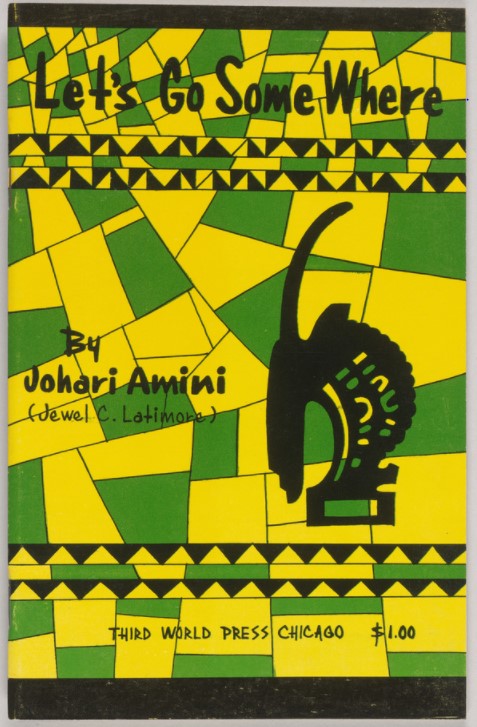
The cover of "Let's Go Some Where" by Johari Amini, designed by Omar Lama. It features a bold, geometric design in yellow, green and black that draws on Afrocentric motifs.
Johari Amini (b. 1935), Let’s Go Some Where, Chicago: Third World Press, 1973. Image courtesy of The Morgan Library and Museum.

One book acquired by The Morgan, Let’s Go Some Where by Johari Amini (aka Jewel C. Latimore) has a striking cover designed by Lama featuring bold, eye-catching colors and Afro-centric imagery. However, Lama’s name is not printed in the colophon where one would usually look for publication information. Instead it is mentioned in an experimental dedication section in the text. Printed on the bottom of the unnumbered page, Amini writes “Thanks to Brother Omar Lama for the creation of the Alive Cover / … that’s what time it is”. 
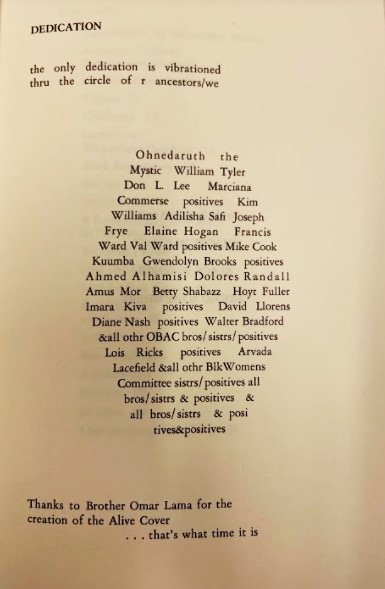
The dedication page of "Let's Go Some Where" by Johari Amini. Printed in black on off-white paper, the dedication text is typeset in a unique hexagonal shape, acknowledging many Black Arts Movement participants. Omar Lama is credited for his cover illustration at the bottom of the page.
Johari Amini (b. 1935), Let’s Go Some Where, Chicago: Third World Press, 1973. Image courtesy of The Morgan Library and Museum.

From the history of this publication, we can tell that Omar Lama’s contribution was essential to the overall feel of the publication and how the intended audience, Black readers, received the work. His connection to AfriCobra and the gratitude from the writers whose covers he designed show the collective impulse of the Black Arts Movement. Because of this, it was essential to capture these elements in the cataloging of these materials for researchers interested in BAM. I kept this in mind when creating the MARC record for Let’s Go Some Where. In addition to fully transcribing Amini’s gratitude statement to Lama in a General Note (500) for the object, I was sure to include Lama’s contribution as cover designer in an Added Entry-Personal Name Note (700).
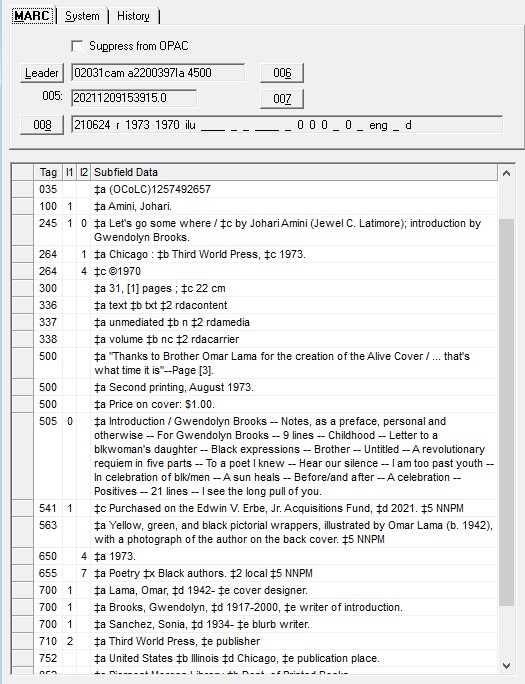
A screen shot from the Voyager Cataloging Module, showing a MARC catalog record for "Let's Go Some Where."
Cataloging Let’s Go Some Where in Voyager cataloging module.

After making sure that these connections could be made locally, the next step was to make sure that Lama’s work could be discoverable by catalogers at other institutions. In consultation with the Manager of Collections Information and Library Systems and The Morgan’s NACO Coordination, I was able to create a Name Authority File record for Lama. Using material from The Morgan’s collection as reference, I was able to add helpful information about Lama such as his place of birth (370), his occupation as an artist (374), and his connection to AfriCobra (373). This makes sure that his work can be consistently attributed when it appears in other publications.
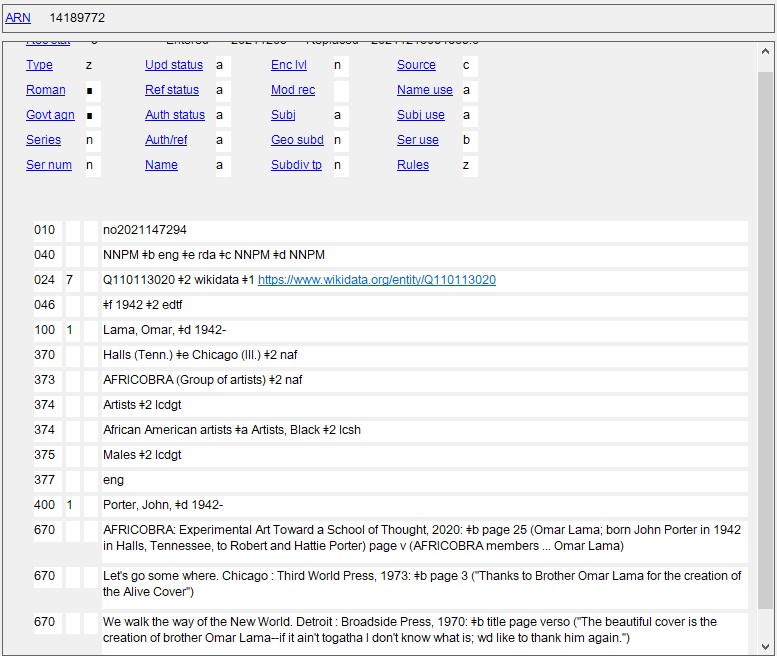
A screen shot from OCLC Connection showing the Name Authority Record for Omar Lama.
Creating Name Authority File Record in OCLC

          The creation of the Name Authority File Record opened up the opportunity to create even more points of access for Lama’s work. His name can now be found in the Virtual International Authority File. Finally, using NAF and VIAF as references, I was also able to create a Wikidata entry for Lama that included more essential information in learning more about his work.

*****

          This example shows how paying close attention to paratextual elements in Black Arts Movement publications can help us question, confront, and improve our cataloging practices.

Categories
backlogs cataloging watson library

Turning a Gifted Backlog into a Multifaceted Valuable Resource

By: Patrick J Raftery Jr

Patrick J Raftery Jr is Senior Library Associate: Technical Services, at The Thomas J Watson Library, The Metropolitan Museum of Art

Backlogs are quite the norm within cataloging and technical services departments. Workflows attempt to manage the processing of materials in a timely fashion. Efforts are put forth to avoid having the backlog multiple in size. However, what does one do when you are gifted another institution’s backlog?

In 2015, The Thomas J Watson Library, at the Metropolitan Museum of Art, was gifted a large backlog from The Museum of Modern Art, MoMA.  The backlog consisted of seventeen skids, each skid consisting of thirty-two bankers boxes, filled with art related materials. Due to the sheer size of the gift, the backlog found its resting space at an offsite facility.  Under the guidance of former Associate Chief Librarian Daniel Starr, former Technical Services Librarian Andrea Puccio and a volunteer began to make a dent in this enormous project. However, the project was suspended in the fall of 2016 to complete the renovation of the Technical Services department, and other high priority projects.

As the renovations of the Technical Services room drew near, Daniel had retired and Andrea relocated to The Clark Art Institute. The MoMA backlog project was brought back to the discussion table for best practices on how to proceed. Under the guidance of John Lindaman, Associate Museum Librarian, Technical Services, the project took an unexpected turn. Instead of overloading the cataloging librarians with this immense project in addition to daily tasks, John approached me, a full-time para-professional member of Technical Services, and MLIS/MA History student at Queens College to become the project manager.

The MoMA backlog project became an educational project for both para-professional staff members and all Watson Librarians who wanted to volunteer their time and/or expand their skill sets in cataloging. To ensure a smooth workflow, that would not create another backlog of work or take away from other responsibilities, interested volunteers were asked to take ten volumes a week. Items are reviewed within the collection development policy. Additional copies of highly circulating volumes are added. For volumes that meet criteria and are not in our collection, OCLC Connexion is used to search for copy cataloging and original records are created if needed. Copy cataloging training/refreshers were provided by John. Para-professional staff who were interested in creating original records, like myself, began a Mentor-Mentee relationship with either Associate Museum Librarian, Principle Cataloger, Tamara Fultz or Assistant Museum Librarian William Blueher. All Chinese, Japanese, Korean (CJK) materials were directed to CJK Museum Librarian Min Xu and Assistant Museum Librarian Luxuan Liu. Volumes with non-roman characters are directed to Tamara and Associate Museum Librarian Jared Ash. Upon creation/completion of full bibliographic records, all new volumes are sent back to the offsite facility for storage and retrieval for patrons.

What at first seemed to be a daunting project has become a successful professional development tool. None of the Watson Library staff members who volunteered to take part in this project has become overwhelmed, overworked, or frustrated with the MoMA backlog. The MoMA backlog has refreshed cataloging rules and best practices for some, and has taught others the fundamentals of cataloging, seeking good copy records and creating good original records. Moreover, we decided against using Backstage Library Marcadia for two important reasons. First, it would take away from the educational value of the volunteers who were interested in becoming skilled catalogers. Second, some of these materials had been sitting in the backlog for an unknown amount of time. We felt it would be best practice to make sure the record is as full as it could be if there was not a record already created.

The progress of the project has been fantastic. During the first stage of the project, the Watson Library acquired 2,280 volumes. 2,109 were cataloged, 111 original cataloging and 1,998 copy cataloged, and 171 added copies. Stage two, the educational volunteer phase, began in the fourth quarter of fiscal year 2017. At the end of fiscal year 2018, the Watson Library has acquired 3,390 volumes, 3,172 volumes were cataloged, 676 original cataloging and 2,496 copy cataloged, and 218 added copies. This brings a combined total of 5,670 volumes added to the Watson Library collection.

We have now completed 43% of the MoMA backlog project. The current workflow consists of receiving, searching, cataloging, and processing, four boxes every two weeks. Since the backlog is housed at an offsite facility, we can pause at any time for higher priority needs or unforeseen circumstances.

The MoMA Backlog Project has become a valuable resource for the Watson Library’s holdings, the Metropolitan Museum of Art curators, the independent researchers, and all of the college and university patrons we serve. It has also sharpened and widened the skill sets of the Watson Library staff. Furthermore, I have truly benefited from the MoMA Backlog Project from the guidance and support of my supervisor, John Lindaman, and my cataloging mentor, Tamara Fultz.

Who would have thought a backlog could provide so much opportunity!

The Cataloging Section welcomes contributions on the topic of cataloging within the art library community. Please share relevant resources, issues, conundrums, projects, cataloging hacks, tips and tricks or news from your library! We would love to hear from catalogers like you.

Categories
Best Practices cataloging conference presentations RDA section meeting

Summer Throwback: ARLIS 2018 Cat Section Meeting Handouts

Amid the stuffy, oppressive, stinky heat of New York City in late August, is it even possible to remember the cooler, albeit grayer, days of late February?

To aid in the quest for refreshing thoughts (or at least a happy distraction), linked here are the handouts from Kelly Swickard’s fantastic mini-presentations at the Cataloging Section’s Annual Meeting at this year’s conference:

Adding Binding Information to Artists’ Book Records, on using the 563 field to add binding characteristics

Cataloging Art Publications, which may be of particular interest; the handout was originally written as a manual for paraprofessional staff, and covers a lot of the particulars of art book cataloging in one brief yet information-packed document. It is RDA-compliant as of late February of this year.

Many thanks again to Kelly for sharing these, and my abundant apologies to everyone for taking so long to get these posted.

Stay cool!


(Image: Photographer unknown. Three women keep cool during a heat wave by moving a park bench into the water in Central Park, New York. September 1961.)

Categories
BIBFRAME cataloging ISNI Linked Data Stanford University Libraries

A Day in the Life of the Transition to BIBFRAME 2.0 and Linked Data

By Kay Teel, Metadata Librarian for Serials and Arts Resources, Stanford University Libraries

My institution is participating in Linked Data projects and the move to BIBFRAME, and all metadata librarians here are involved in these efforts in some way. What does this “bleeding edge” participation look like from the trenches? What follows is a snapshot.

Start the morning off right with a large chai latte and some identity management. A shared spreadsheet contains hundreds of names that never underwent authority control. Each librarian selects a few dozen names to work on. The first step is to search the Library of Congress authority file through its Linked Data Service. If the name is the Name Authority File (NAF), I input the name’s URI into the spreadsheet. If the name is not in NAF, I go to ISNI, as my institution is participating in the PCC ISNI Pilot Project.

Searching ISNI is challenging because there are many duplicates, and each different kind of search (for example, “any phrase” or “name keyword”) yields different results. If the name is in ISNI, I input the name’s ISNI URI in the spreadsheet. If it’s not in ISNI, I login to the ISNI production database website to create a new ISNI record. There are not a lot of required fields, and ISNI doesn’t follow any set of cataloging rules, only its own guidance. I input the name, title of the resource where the name came from. Any other information I have about the name (such as language of the resource) is optional. After I save the record, it is in provisional status until eventually it is reviewed to become an assigned ISNI. After it is assigned, there is an ISNI URI available for the name.

What a search result looks like in the ISNI production system


For some projects I also search ORCID and input ORCID identifiers for names found there.

At lunchtime, chances are there will be a webinar about FRBR-LRM, RDF, or Linked Data project updates.

After lunch, I attend a weekly team meeting of five colleagues who are building BIBFRAME Profiles to be used in my institution’s BIBFRAME Editor. During the meeting we look at the latest behavior of our profiles by examining the JSON-LD output and RDF graphs. Building a profile requires reading the BIBFRAME 2.0 vocabulary and mapping the properties and classes to the appropriate level (Work, Instance, or Item), finding vocabulary sources such as Library of Congress’s Linked Data Service or the RDA Registry, and a lot of troubleshooting. Our profiles are built on a web form based on the Library of Congress’s BIBFRAME Profile Editor, and the team monitors changes LC makes through their Github code depository.


After the meeting, I have tasks to complete on my assigned BIBFRAME Profile (for serials). Today’s tasks include going through the list of unconstrained properties at the RDA Registry and deciding which ones are required for serials, and which ones are not relevant or nonessential for serials. I also need to de-bug some existing modeling to figure out why some of the RDF triples ended up floating by themselves in the RDF graph (not supposed to happen!).


After I track down the bug (some errant properties had been modeled to take literal strings as their objects, but the only valid objects for them are BIBFRAME classes), I have some time to review a file of vendor-supplied MARC records containing URIs in subfield zero ($0) of access points such as names, subject headings, and series. This requires plugging the URI in a browser and seeing what data results. If the data appears to match the name in the MARC record, it’s good. If not, I highlight the field in the file and mark it as a mistake. The URIs come from the Library of Congress Linked Data Service Name Authority File, ISNI, or VIAF.

At the end of the day, I work on assignments for the Python programming course I’m taking, and if there is time before I need to catch the train home, I do some RDA cataloging in MARC in OCLC.

(This essay reflects the personal opinions of the author and not the official views or policies of Stanford University Libraries)

The Cataloging Section welcomes contributions on the topic of cataloging within the art library community. Please share relevant resources, issues, conundrums, projects, cataloging hacks, tips and tricks or news from your library! We would love to hear from catalogers like you.

Categories
backlogs cataloging conference presentations met museum

Beyond the Backlog: How the Thomas J. Watson Library Made Their Backlog Disappear

Those who were in New Orleans for the 2017 ARLIS/NA conference in New Orleans earlier this year may remember Tamara Fultz’ fascinating presentation at the last Cataloging Section meeting.  Titled “Beyond the Backlog: How the Thomas J. Watson Library Made Their Backlog Disappear”, this PowerPoint presentation (click the link below to download!) is a valuable summary for any cataloger or librarian looking for solutions to a seemingly endless backlog.

Tamara Fultz is the Associate Museum Librarian, Principal Cataloger, at the Thomas J. Watson Library at the Metropolitan Museum of Art in New York City.

BeyondtheBacklog  (click link to download)

Photo credits listed below.

Empty backlog Watson pic
Shelves where the Watson Library’s backlog used to be!


Watson
View of the main reading room at the Thomas J. Watson Library at the Metropolitan Museum of Art


met- library entrance
Entrance view to the Thomas J. Watson Library at the Metropolitan Museum of Art: 
Patio from the Castle of Vélez Blanco, Gallery 534


DP336465-JPG_Original_300dpi
View of the Thomas J. Watson Library at the Metropolitan Museum of Art: Samuel Yellin’s Door and Key in Original Door Frame in Watson Library

Images in this post: 
– Tamara Fultz
– https://www.metmuseum.org/blogs/in-circulation/2014/welcome
– http://www.artlibrarycrawl.com/2012/09/the-metropolitan-museum-of-art-thomas-j.html
– https://www.metmuseum.org/blogs/in-circulation/2017/samuel-yellin